V001 / JSI

LinkedIn Facebook Twitter TikTok Instagram TV IJS Kolokviji IJS   | Arhiv novic | News Archive | Video arhiv |   Evropski kmetijski sklad za razvoj podeželja    Načrt za okrevanje in odpornost

Slovensko   English2026-02-10

Zlati znak Jožefa Stefana

News Archive

Shih-Kai Chou, Jernej Hribar, Vid Hanžel, Mihael Mohorčič and Carolina Fortuna from the Department of Communication Systems of the Jožef Stefan Institute published a paper entitled The energy cost of artificial intelligence lifecycle in communication networks in the prestigious IEEE Journal on Selected Areas in Communications. In the paper, they analyzed the complexity of data collection and manipulation in individual components of an information-communication system and derived overall and per‑bit energy consumption. They proposed a new metric, the energy cost of AI lifecycle (eCAL), which allows for the quantification of the total energy consumption from development to deployment and utilization of machine learning models providing artificial intelligence in communication networks. The authors are the first to combine the previously separate monitoring of energy consumption in communication, computing infrastructure and the development and use of machine learning models, which forms the baseline for sustainable introduction of intelligent functionalities into smart infrastructure systems.

News Archive

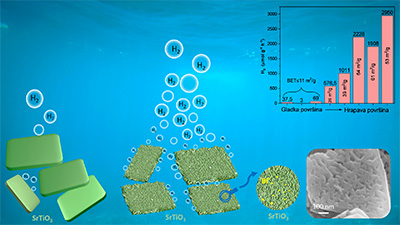
The research group of the Advanced Materials Department at the Jožef Stefan Institute, in collaboration with researchers from the National Institute of Chemistry and National Taiwan University, has published a new article in the Chemical Engineering Journal entitled: Steering the Bi₄Ti₃O₁₂-to-SrTiO₃ hydrothermal transformation for controlling the functionality of two-dimensional (2D) SrTiO₃ nanoplatelets for photocatalytic H₂ evolution. The work provides an in-depth understanding of how 2D Bi₄Ti₃O₁₂ nanoplatelets can be transformed, via low-temperature hydrothermal processing, into 2D SrTiO₃ nanostructures with tailored surface roughness and surface-trapped monoatomic bismuth species. These features significantly enhance photocatalytic hydrogen evolution, achieving more than a 50-fold increase in efficiency compared to their smooth-surfaced counterparts. The study not only demonstrates how to engineer the functional properties of SrTiO₃ nanoplatelets, but also opens new pathways for designing other 2D perovskite nanostructures derived from Aurivillius phases through low-temperature topochemical transformations. This work represents a contribution to the HetCat project under the M-era.NET initiative.

News Archive

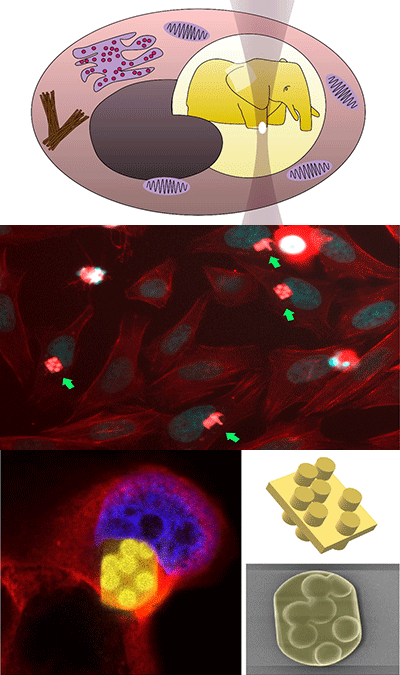
Researchers Dr. Maruša Mur, Aljaž Kavčič, Dr. Uroš Jagodič, Dr. Rok Podlipec, and Assoc. Prof. Dr. Matjaž Humar from the Department of Condensed Matter Physics at the Jožef Stefan Institute have succeeded in 3D printing microscopic structures directly inside living human cells using two advanced techniques. First, they injected a drop of biocompatible light-sensitive material into the cell. Then, using a highly focused laser beam, they selectively illuminated the printing material and polymerized it. By moving the laser beam in three dimensions, it is possible to "draw" complex structures of any shape with sub-micrometer resolution. Using this method, the team printed various structures, from geometric patterns to microlasers and even small elephants, all inside living human cells. By transforming living cells into miniature environments for 3D printing, this work pushes the boundaries of what is possible at the intersection of biology, physics, and engineering, offering a powerful new tool for exploring the workings of life from the inside out. The research was published in the prestigious journal Advanced Materials.

News Archive

Sara Klopčič, Aljaž Kavčič and dr. Matjaž Humar from Lab for biophotonics, soft photonics and quantum optics and Condensed matter physics department at Jožef Stefan Institute and Faculty of Mathematics and Physics at the University of Ljubljana have together with Dr. Nerea Sebastian from Department of Complex Matter demonstrated, in a recently published article Electrically and Geometrically Tunable Photon Pair Entanglement from Ferroelectric Nematic Liquid Crystal in Advanced Science, that quantum-entangled photon pairs can be generated in ferroelectric nematic liquid crystals (FNLCs), while simultaneously allowing continuous control over the degree of quantum entanglement. This control can be achieved by adjusting the sample thickness and molecular twist, or in real-time by applying an external electric field. Such continuous and real-time tunability represents an important advantage of liquid crystals over classical solid nonlinear crystals and paves the way for the development of so-called quantum displays.

IN FOCUS


STRATEGIC PROJECTS

Strategic Projects


COLLOQUIA

Colloquia


VIDEO ARCHIVE

Video Archive


PRINTED NEWS

Printed News   CasopIJS


GENDER EQUALITY AT JSI

Gender Equality at JSI


FOOD AT JSI

Food at JSI


JOB OPPORTUNITIES

Job Opportunities

The Jožef Stefan Institute invites interested researchers and others to joint our teams.
Posts


PHD PROGRAMMES

Postgraduate School

The JOŽEF STEFAN INTERNATIONAL POSTGRADUATE SCHOOL, in collaboration with the INSTITUTE JOŽEF STEFAN, begins enrollment for doctoral and master's degrees.

J. Stefan Institute, Jamova cesta 39, 1000 Ljubljana, Slovenia, Telephone: +386 1 477 39 00
info@ijs.si